Cerebrolysin — the leaflet in plain English: dosage, dilution, administration
A medicine's leaflet is written for the doctor, not the patient. We translate the part that matters: what an ampoule contains, which dose is given for which indication, why anything above 10 ml is given only as a diluted infusion, and what must not be mixed into the infusion bag.
English translation of content medically reviewed in Romanian by Dr. Claudiu Ruscu, intensive care physician (anaesthesia & intensive care)· Romanian text reviewed 13 September 2026
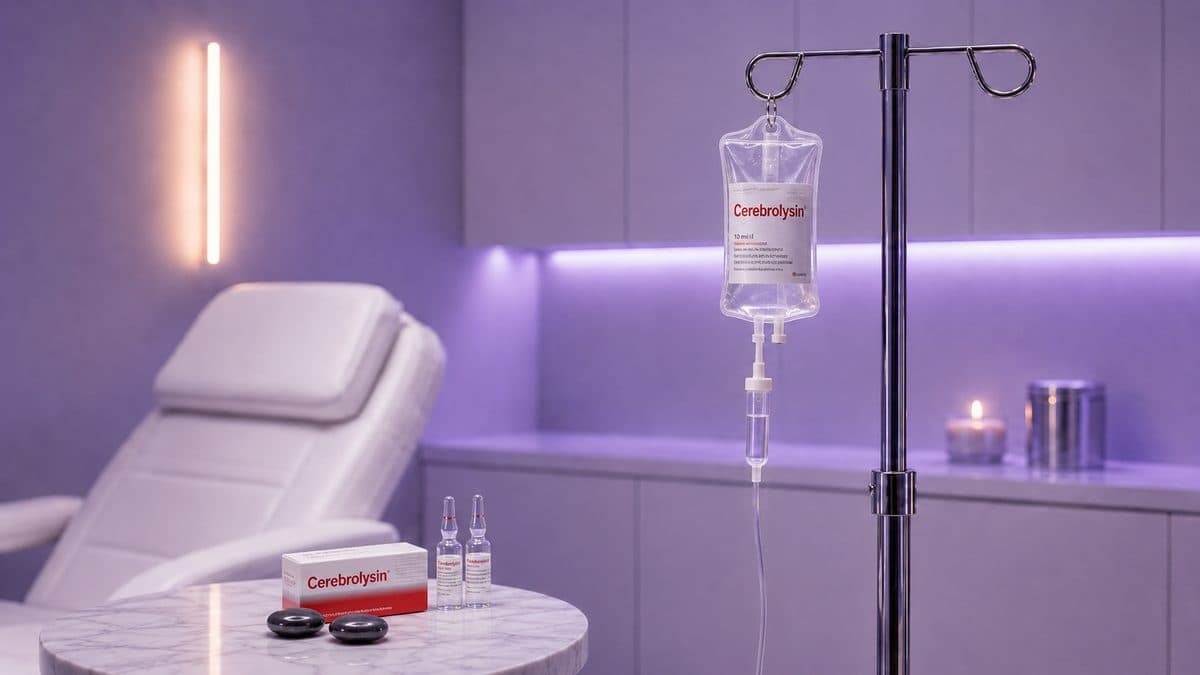
If you have landed here with a prescription in your hand or an ampoule on the table, the leaflet helps you less than it should — it is written for the doctor. This article translates the part that matters for someone about to start the treatment.
For context — what the substance is, what indications it has and what independent studies show — read the complete guide to Cerebrolysin first. Here we deal strictly with administration.
The concentration does not change. Only the ampoule does.
The most common confusion: people search for a “more concentrated Cerebrolysin”. It does not exist. The concentration is fixed at 215.2 mg of concentrate per millilitre, in every ampoule size. What changes is the total amount.
| Ampoule | Concentrate | Route of administration |
|---|---|---|
| 1 ml | 215.2 mg | intramuscular |
| 5 ml | 1,076 mg | intramuscular or slow intravenous |
| 10 ml | 2,152 mg | slow intravenous or diluted infusion |
| 20 ml | 4,304 mg | diluted infusion only |
The rest of the solution is sodium hydroxide and water for injections.
Which dose, for which indication
The doses on the leaflet differ according to the reason it is being given:
- organic and neurodegenerative brain disorders — 5–30 ml a day;
- complications after a stroke — 10–50 ml a day;
- traumatic brain injury — 10–50 ml a day.
Note the ranges: they are wide, and choosing within them is not a matter of preference. The doctor sets it, according to the diagnosis, age and kidney status.
The golden rule: above 10 ml, infusion only
This is where mistakes are made most often, and the mistake is not cosmetic.
- up to 5 ml — may be given intramuscularly;
- up to 10 ml — may be given intravenously, slowly;
- 10–50 ml — only by infusion, diluted.
It is diluted to a total volume of about 250 ml, in saline, Ringer's solution or 5% glucose, and the infusion runs over 15–60 minutes.
The reason is simple: a large amount of protein hydrolysate pushed quickly into the circulation is exactly the situation in which a hypersensitivity reaction becomes dangerous. Dilution and time are safety measures, not formalities.
What must NOT go in the same bag
Cerebrolysin must not be mixed in an infusion with amino acid solutions. This is an explicit incompatibility on the leaflet, not a general precaution.
The practical rule: if you are also having an amino acid protocol, it is given separately, not through the same line at the same time.
It is not an injection, it is a course
The leaflet describes treatment as a course: daily administration for 10–20 days. A one-off session is not the regimen described in the authorisation — it is one part of a regimen set by the doctor.
If someone offers you “a Cerebrolysin infusion” as a single event, with no diagnosis and no plan, the right question is which indication is being treated.
Contraindications
- hypersensitivity to Cerebrolysin or to the components of the solution;
- epilepsy and status epilepticus;
- severe kidney failure.
The side effects reported on the leaflet are overwhelmingly very rare — fewer than 1 in 10,000 administrations — and include hypersensitivity reactions, headache, nausea, a burning sensation at the injection site, chills. That does not mean they do not exist; it means administration must take place where someone can recognise and treat them.
One nuance we want to flag: the patient leaflet, approved in 2012, refers to severe kidney failure, while the summary of product characteristics published on Mediately, updated in 2016, lists kidney failure among the contraindications, without qualification. In practice, this means kidney function is discussed beforehand, whichever document you go by.
What to tell the doctor before the first administration
The leaflet and the SmPC (summary of product characteristics) name a few situations that need special attention, apart from the contraindications:
- antidepressants or monoamine oxidase inhibitors (MAOIs) — additive side effects may occur; in these cases the SmPC recommends lowering the antidepressant dose, a decision that belongs to the doctor who prescribed it;
- an allergic tendency — “allergic diathesis”, in the leaflet's terms;
- epilepsy or grand mal seizures — the treatment may increase the frequency of seizures;
- pregnancy and breastfeeding — there are no human data; Cerebrolysin is used only after a careful assessment of the balance between risk and benefit.
Vitamins and cardiovascular medicines may be given during the same period, but they are not mixed in the same syringe or bag as Cerebrolysin.
Why the rate of administration matters
Among the rare side effects, the leaflet links several directly to administration that is too fast: dizziness, palpitations and rhythm disturbances, a feeling of warmth and sweating. That explains why the diluted infusion runs over 15–60 minutes and why, with us, it takes 45–60 minutes.
The leaflet also contains an honest note: because the medicine is used a lot in older people, some of the reported reactions are typical of this age group and can occur without treatment. That is why a reaction that appears after an infusion is discussed with the doctor rather than attributed automatically.
What the leaflet says about repeating courses
Besides the 10–20-day course, the leaflet also describes what comes next: after the initial course, the frequency may be reduced to 2–3 administrations a week, and between courses there is a break equal in length to the course. Whether and when a course is repeated is decided by the doctor who set the indication, according to progress.
Packs, storage and the appearance of the solution
In the Medicines Nomenclature of the National Agency for Medicines (ANM, Romania's medicines regulator), updated on 11 September 2026, Cerebrolysin 215.2 mg/ml is listed in four packs — boxes of 10 ampoules of 1 ml and of 5 ampoules each of 5 ml, 10 ml and 20 ml — all dispensed on prescription.
From the SmPC, the storage and handling rules:
- store below 25°C, in the original pack;
- draw the solution from the ampoule only immediately before use, and discard whatever is left — the ampoule is single-use;
- use only a clear, slightly yellowish (amber) solution;
- it is incompatible with solutions that alter pH (the SmPC gives the range 5.0–8.0) and with solutions containing lipids;
- when given through a long-term catheter, the line is flushed with saline before and after.
Overdose and missed doses
The leaflet notes that no harmful effects on health are known following an overdose or poisoning — and the risk is small anyway, because the medicine is given by medical staff. If a day of the course is missed, the next dose is not doubled.
What you will not find on the leaflet
The leaflet says how the medicine is given and for which indications it is authorised. It does not say how well it works compared with placebo, nor what independent reviews have found. For that we have written separately about what the studies show about Cerebrolysin — including the results that do not favour it.
How it is done at Synerva
A single protocol, with no variants: one 10 ml ampoule (2,152 mg), diluted in 250 ml saline, given over 45–60 minutes, only at the clinic, with monitoring throughout. It is given on the basis of a documented neurological diagnosis and after a medical assessment — not on request.
Details and price: Cerebrolysin infusion.
Sources
For information only. Cerebrolysin is a prescription-only medicine; the dose and regimen are set by the doctor, after assessing each case.
Frequently asked questions
- How many ml of Cerebrolysin can be given intramuscularly?
- Up to 5 ml. Above that amount it is given slowly into a vein (up to 10 ml) or as a diluted infusion (10–50 ml). This is not a convention; it is the limit on the leaflet.
- What is Cerebrolysin diluted in?
- In saline, Ringer's solution or 5% glucose, to a total volume of about 250 ml. The infusion is given over 15–60 minutes.
- Can it be mixed with other infusions?
- Not with amino acid solutions — that is an explicit incompatibility on the leaflet. If both are indicated, they are given separately.
- How many days does a course last?
- The leaflet describes daily administration for 10–20 days. A one-off session is not the regimen in the authorisation; the length is set by the doctor according to the indication.
- What are the contraindications?
- Hypersensitivity to its components, epilepsy and status epilepticus, severe kidney failure. They are checked at the medical assessment before the first administration.
- Can I have Cerebrolysin if I take antidepressants?
- You must tell the doctor beforehand. The SmPC draws attention to possible side effects in combination with antidepressants or monoamine oxidase inhibitors and recommends, in these cases, lowering the antidepressant dose. The decision is the doctor's, not the patient's.
- How are Cerebrolysin ampoules stored?
- Below 25°C, in the original pack. The solution is drawn up only immediately before use, the rest is discarded, and only a clear, slightly yellowish (amber) solution is used.
- What happens if the infusion runs too fast?
- The leaflet describes, as rare reactions linked to administration that is too fast, dizziness, palpitations and rhythm disturbances, a feeling of warmth and sweating. That is why doses above 10 ml are given diluted, as an infusion over 15–60 minutes.
More in Guides
- How much a Cerebrolysin infusion costs: what the price includes and what a course costs
At Synerva, a session costs 300 RON and includes the medical consultation, the 10 ml ampoule, the infusion and monitoring. What that means for a 10–20-day course, and what needs settling before you book.
- TAD 600 and glutathione in ampoules — what it is, what the leaflet says, what to know beforehand
Anyone searching for "glutathione ampoules" quickly lands on TAD 600. We explain what the product contains, which indications the manufacturer attributes to it and where it is actually sold in Romania — because the answer to the last question matters more than the first two.
- Liposomal or injectable glutathione — what the real difference between them is
Plain oral glutathione is broken down before it gets where it needs to go. The liposomal form tries to solve exactly that, and the IV drip bypasses the problem altogether. Which makes sense for whom — and where, honestly, the evidence stops.
- NAD+ IV drip — the price in Romania and what determines it
Prices for injectable NAD+ vary a lot, and the differences are not arbitrary. What exactly you are paying for, why the 250 mg dose costs more than twice the 100 mg dose and what should put you on guard with a very cheap offer.
SYNERVA services related to this article
Thinking of trying it?
We start with a medical assessment — we tell you which protocol makes sense for you and which doesn't. Published prices, no surprises.
Book an assessment