Cerebrolysin: divided opinions — and what independent studies actually show
On forums you will find both “it changed my life” and “I felt nothing”. Both are sincere and neither is evidence. What the systematic reviews say instead, including where the result is disappointing.
English translation of content medically reviewed in Romanian by Dr. Claudiu Ruscu, intensive care physician (anaesthesia & intensive care)· Romanian text reviewed 13 September 2026
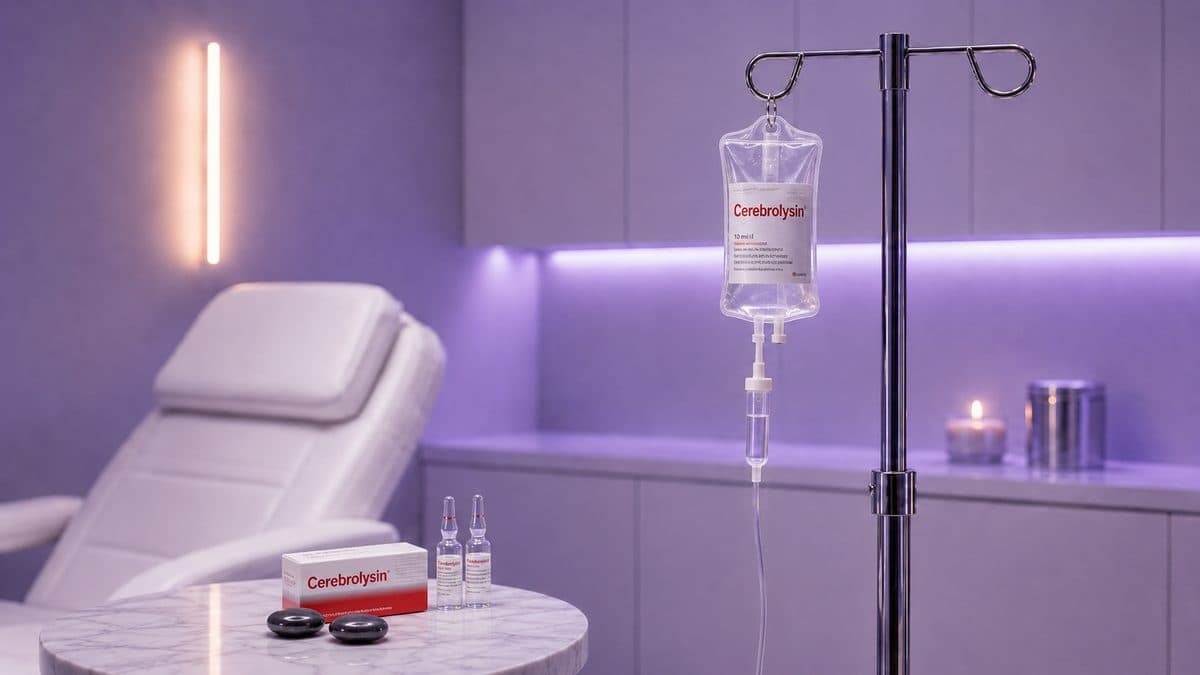
Search for “Cerebrolysin reviews” and you will find two camps, each equally convinced. This article does not try to prove either of them right. It tries to explain why both can be sincere and why neither answers the question you are actually asking: *will it do me any good?*
Why personal opinions do not answer the question
Not because people lie. Because three things get mixed up and cannot be separated in an individual story:
Natural recovery. Cerebrolysin is most often given after a stroke or a head injury — exactly the periods when the body recovers anyway, with or without treatment. Someone who receives the treatment in the month they would have improved anyway will associate it with the improvement. The rest of the treatment. Almost nobody receives Cerebrolysin alone. There is physiotherapy, speech therapy, other medicines, a rehabilitation setting. Improvement has many parents. Who ends up writing. People for whom it went well tell their story more often than those for whom nothing changed. It is not bad faith; it is how any collection of testimonials takes shape.This is exactly why clinical trials exist: not to contradict anyone's experience, but to separate the effect of the medicine from everything else.
What the independent reviews found
A Cochrane review gathers all the studies on a topic, weighs their quality and draws a conclusion from all of them together. It is the closest thing to an honest answer. For Cerebrolysin there are two.
Acute ischaemic stroke
The review updated in October 2023, covering seven trials and 1,773 participants, found that:
- there is probably no difference in mortality;
- the number of non-fatal serious adverse events is probably higher in the treated group.
It is not a comfortable result for anyone selling the treatment. That is also why we are writing it down.
Vascular dementia
The review on vascular dementia found a modest effect on cognitive function — but the authors warn that the data are not definitive and that the benefit may be too small to matter clinically.
“Too small to matter” does not mean zero. It means the difference measured in tests may not show up in the patient's everyday life.
What lies behind the words “very low quality”
The vascular dementia review found a favourable effect both on cognitive function and on the patient's global assessment. Both results, however, were rated as very low-quality evidence: the trials were heterogeneous, with a high risk of bias, and where funding was declared — three trials — all were supported by the pharmaceutical industry. Only one trial reported mortality, none reported quality of life or caregiver burden.
The authors note one more thing: since the first version of the review, in 2013, no new eligible trial has appeared, even though the medicine continues to be used and promoted for this indication.
What “more non-fatal serious adverse events” means
In acute stroke, the 2023 review found that the total number of people with serious adverse events is probably similar between groups. When these were separated, fatal events did not differ, but non-fatal ones had a risk about 2.4 times higher in the treated group — across three trials with 1,335 participants, with a moderate level of confidence. With the regimen of 30 ml a day for 10 days, the difference was even more pronounced.
The review also notes that the manufacturer supported three of the multicentre trials included — wholly or by supplying the medicine and placebo, randomisation codes, grants or statisticians.
The largest trials, one by one
Reviews gather trials. A few of them are worth looking at individually, because many of the opinions quoted online come from them.
The CASTA trial (2012) is the largest trial in acute stroke: 1,070 patients in Asia, treated with 30 ml a day for 10 days, starting within the first 12 hours. The primary endpoint showed no difference from placebo. A later analysis of patients with severe forms suggested a favourable trend, but the authors wrote explicitly that the observation needs to be confirmed by a new trial.
The CARS trial (2016) included patients in rehabilitation after a stroke, treated with 30 ml a day for 21 days alongside a standard rehabilitation programme; its authors include researchers from Romanian university centres. It reported a favourable effect on upper-limb function at 90 days. The authors, however, described it as an exploratory trial on a relatively small sample, with results that need confirming in a large trial — and the authors include employees of the manufacturer.
The CAPTAIN series (2021) was analysed in a meta-analysis of two trials in moderate-to-severe traumatic brain injury, with 185 patients in total, which reported a small-to-medium effect at 30 and at 90 days. It is a small analysis, carried out by some of the same researchers involved in CARS.
Why the results seem to contradict each other
The trials do not contradict each other as much as it seems. The difference comes from what each one measures:
- the endpoint set in advance matters more than analyses done afterwards — CASTA was neutral precisely on its primary endpoint;
- a small, exploratory trial can give a signal, but does not confirm it;
- composite scores built from several scales can show an effect where a simple outcome, such as mortality, shows nothing;
- manufacturer involvement does not invalidate a trial, but it is a reason to wait for independent confirmation.
How to read an opinion on a forum
- What diagnosis did the person have, and how long had it been since the stroke or injury?
- What other treatment and rehabilitation were they having at the same time?
- What changed, concretely — and how was it measured?
- Is the writer someone who finished the treatment, or someone who has only just started it?
- Does the person writing sell or recommend the treatment?
What this means in practice
Cerebrolysin is not a medicine without effect, but nor is it one with a convincingly demonstrated effect. It sits in an uncomfortable zone, where the decision is made case by case, not on principle — by the doctor who knows the diagnosis, the alternatives and the rest of the regimen.
What can be said with certainty:
- it has approved indications — after-effects of stroke, traumatic brain injury, neurodegenerative brain disorders;
- it has no indication for tiredness, stress, “brain fog” or improving memory in a person without a neurological diagnosis;
- the evidence in humans is limited and, in acute stroke, unfavourable.
What we do with this at Synerva
We give it only on the basis of a documented neurological diagnosis and after a medical assessment, only at the clinic. We do not present it as a longevity protocol and we do not promise cognitive results.
If the reason you are searching is tiredness or a wish to support cognitive function without a diagnosis, the honest answer is that Cerebrolysin is not the answer, and the right conversation starts with a medical assessment.
The full context — what the substance is, how it is given, contraindications — is in the guide to Cerebrolysin.
Sources
For information only. It does not replace a medical consultation; the decision to give the medicine rests with the doctor.
Frequently asked questions
- Does Cerebrolysin really work?
- It depends on the indication, and the honest answer is “not convincingly demonstrated”. The Cochrane review on acute ischaemic stroke (7 trials, 1,773 participants) found that there is probably no difference in mortality and that non-fatal serious adverse events are probably more frequent. In vascular dementia a modest effect was found, with the caveat that it may be too small to matter clinically.
- Why are opinions so divided?
- Because it is given exactly during the periods when the body recovers anyway, alongside other treatments, and people for whom it went well tell their story more often. All three mean that individual experience cannot separate the effect of the medicine from everything else.
- Does it help memory and concentration?
- It has no indication for that. The approved indications are neurological: after-effects of stroke, traumatic brain injury and neurodegenerative brain disorders. Using it for “brain fog” or cognitive performance in a healthy person is outside its marketing authorisation.
- Is it worth having if my doctor recommended it?
- The decision belongs to the doctor who knows the diagnosis, the alternatives and the rest of the regimen. What you can do is ask which indication is being treated and what exactly is expected from the treatment — questions any doctor will answer without difficulty.
- What did the largest Cerebrolysin trial show?
- The CASTA trial, in 1,070 patients with acute ischaemic stroke, found no difference from placebo on its primary endpoint. A later analysis of severe forms suggested a favourable trend, but the authors stated that it needs to be confirmed by a new trial.
- Are there Cerebrolysin studies carried out in Romania?
- Yes. The CARS trial, on recovery after stroke, has authors from Romanian university centres and reported a favourable effect on upper-limb function, but the authors described it as exploratory, on a relatively small sample, and they include employees of the manufacturer. And one of the six trials in the Cochrane review on vascular dementia was carried out in Romania.
- Who funded the studies on Cerebrolysin?
- A significant share was supported by the manufacturer. The 2023 Cochrane review on stroke notes that the manufacturer supported three multicentre trials, and the 2019 review on vascular dementia shows that all trials with declared funding were supported by industry. That does not automatically invalidate the results, but it is a reason to wait for independent confirmation.
More in Science
- The truth about glutathione — what is proven, what isn't, and what the authorities have warned about
Glutathione is a real molecule, with a real role. The problem is the gap between what it does in the cell and what is attributed to it on the internet. We put the two side by side — including the part that works against us.
- NADH and NAD+ — the difference, the claimed benefits and the contraindications
On the shelves you will find both NAD+ and NADH, presented as rival products. In reality they are the same molecule in two states. What this means for what you buy and what you should know first.
- Fatigue, B vitamins and magnesium: what to check before an IV drip
B vitamins and magnesium play real roles in energy metabolism, but persistent fatigue most often comes from sleep, stress or depression, and sometimes from anaemia or a thyroid problem. What is checked first, what these nutrients do and when injectable administration makes sense.
- Magnesium, stress and sleep: what the studies show, when oral is enough and when it is not
Magnesium is among the most popular supplements for sleep and stress. The studies are few, small and have mixed results. What the reviews found, which foods provide it, when the oral route is enough and in what contexts intravenous administration makes sense.
SYNERVA services related to this article
Thinking of trying it?
We start with a medical assessment — we tell you which protocol makes sense for you and which doesn't. Published prices, no surprises.
Book an assessment