Cerebrolysin: what it is, how it is given and what the studies actually show
Cerebrolysin is a prescription medicine, not a supplement and not a “memory booster”. What an ampoule contains, its licensed indications, why doses above 10 ml are given only as a diluted infusion, and what the Cochrane reviews found — including the uncomfortable part.
English translation of content medically reviewed in Romanian by Dr. Claudiu Ruscu, intensive care physician (anaesthesia & intensive care)· Romanian text reviewed 2 September 2026
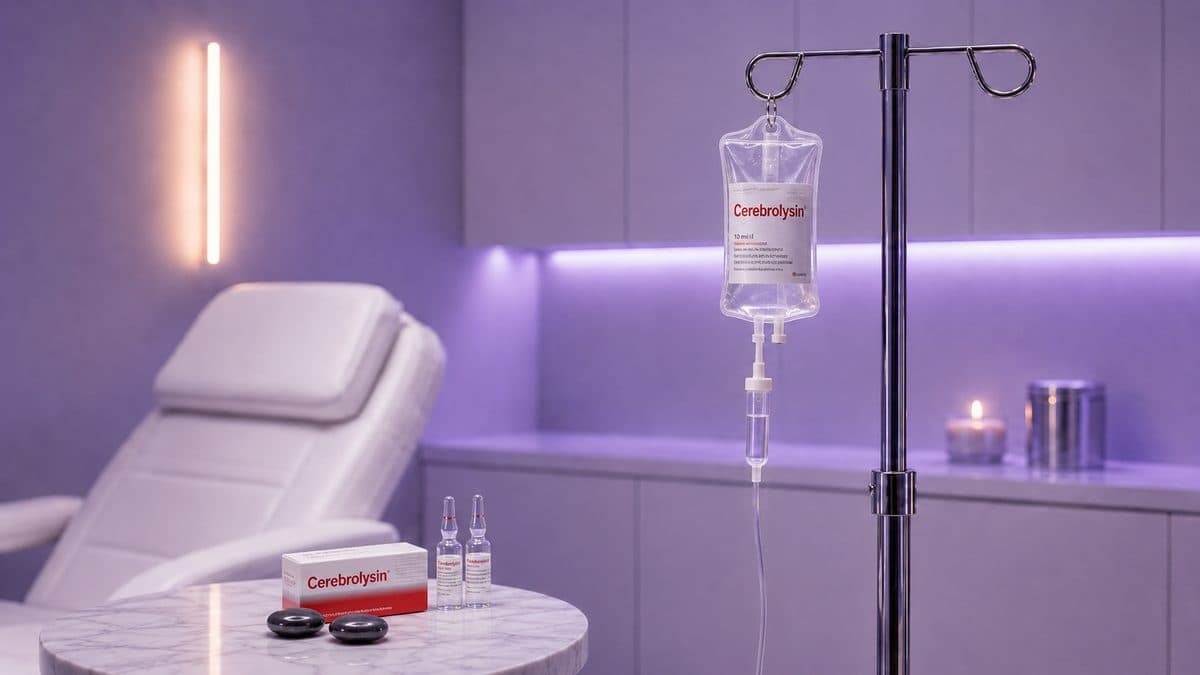
In Romania you will see it written two ways: cerebrolizin, the way it is usually pronounced and spelled in Romanian, and Cerebrolysin, the brand name on the leaflet. It is the same medicine — we use both names in this article, because both are searched for just as often.
Cerebrolysin is searched for in Romania for two very different reasons: either because a neurologist prescribed it after a stroke or a head injury, or because someone read somewhere that it “helps memory and concentration”. The first situation is covered by the leaflet. The second is not.
This article explains what the substance is, what its marketing authorisation says and what independent systematic reviews have found — including where the results are disappointing. We do not sell cognitive promises.
What it is, in concrete terms
Cerebrolysin is a porcine brain protein hydrolysate: a mixture of low-molecular-weight peptides and free amino acids, obtained by controlled enzymatic breakdown. It sits under ATC code N07XX — other nervous system drugs.
The concentration is fixed at 215.2 mg of concentrate per millilitre, whatever the size of the ampoule. The rest of the solution is sodium hydroxide and water for injections. There is no “more concentrated” version — there are only larger ampoules.
| Ampoule | Amount of concentrate | Route of administration |
|---|---|---|
| 1 ml | 215.2 mg | intramuscular |
| 5 ml | 1,076 mg | intramuscular or slow intravenous |
| 10 ml | 2,152 mg | slow intravenous or diluted infusion |
| 20 ml | 4,304 mg | diluted infusion only |
The packs authorised in Romania are boxes of 10 ampoules of 1 ml, 5 ampoules of 5 ml and 5 ampoules of 10 ml.
The indications on the leaflet
This is the part worth reading before anything else. The approved indications are neurological and limited:
- organic, metabolic and neurodegenerative brain disorders — in particular senile dementia of the Alzheimer type;
- complications after a stroke;
- traumatic brain injury — post-operative, contusions or concussion.
What is not on this list: tiredness, stress, “brain fog”, reduced performance at work, ageing itself. Cerebrolysin has no indication for improving memory in a person without a neurological diagnosis, and using it for that purpose is outside its marketing authorisation.
How it is given, according to the leaflet
The doses differ by indication:
- organic and neurodegenerative brain disorders: 5–30 ml a day;
- complications after a stroke: 10–50 ml a day;
- traumatic brain injury: 10–50 ml a day;
- children: 1–2 ml a day.
The route of administration depends strictly on the volume. Up to 5 ml may be given intramuscularly, up to 10 ml intravenously. Doses of 10–50 ml are given only by infusion, diluted to a total volume of 250 ml in 0.9% saline, Ringer's solution or 5% glucose. The infusion must last between 15 and 60 minutes.
A detail that advertising almost always leaves out: the leaflet describes a course of treatment — daily administration for 10–20 days — not a one-off infusion. A single session is not a course; it is one session of a regimen set by the doctor.
What the studies show — the honest part
This is where this article parts ways with most Romanian writing on the subject.
Acute stroke
The Cochrane review updated in October 2023 analysed seven randomised trials with 1,773 participants. Its conclusions, in brief:
- Cerebrolysin probably makes no difference to all-cause mortality — moderate-certainty evidence.
- It probably increases the number of patients with non-fatal serious adverse events.
- None of the included trials reported poor functional outcome, defined as death or dependency at the end of follow-up — exactly the measure that would matter most to a patient.
The authors note explicitly that three of the trials involved the manufacturer, which may have influenced how they were designed.
Vascular dementia
The Cochrane review on vascular dementia, updated in November 2019, included six randomised trials with 597 participants. It found a modest beneficial effect on cognitive function and global function, with no difference in the rate of adverse reactions — but the authors warn that the data are not definitive and that, if the benefits exist, they may be too small to matter clinically. Their conclusion is that methodologically robust trials with adequate statistical power are needed.
Between the 2013 review and the 2019 update, no new trials appeared that could be included. For a medicine that has been in use for decades, that in itself is information.
What this means in practice
That Cerebrolysin is not a treatment with solidly demonstrated efficacy, but a medicine with approved indications and a weak, contested evidence base. Anyone who promises you certain cognitive results is not citing the literature — they are ignoring it.
Contraindications and side effects
It is not given in case of hypersensitivity to its components, epilepsy or severe kidney failure.
Side effects reported very rarely include hypersensitivity reactions, seizures, gastrointestinal disturbances and injection-site reactions. Rarely: loss of appetite, agitation or confusion, palpitations, rises or falls in blood pressure, tremor, depression.
Because it is a protein hydrolysate, the practically relevant risk is a hypersensitivity reaction. That is why it is given where there are staff and equipment to intervene, not at home.
Cerebrolysin, Neurovert or Actovegin — not the same thing
Three names that often turn up in the same search, even though they are not even in the same category. The difference matters, because it changes who decides and how the product is taken.
| What it is | How it is taken | Available without a prescription? | |
|---|---|---|---|
| Cerebrolysin | Medicine — a peptide hydrolysate from porcine brain | Injection or infusion | No |
| Neurovert Forte | Food supplement — citicoline 500 mg and Bacopa monnieri extract | Capsules, by mouth | Yes |
| Actovegin | Medicine — a deproteinised haemoderivative from calf blood | Tablets, injection or infusion | No |
Which of them — if any — makes sense in a given case is not decided from a table, but by the doctor who makes the diagnosis.
How we work at Synerva
We give it only at the clinic, only on the basis of a documented neurological diagnosis and after a medical assessment — not on request and not as a wellness protocol. The first step is always the assessment, not the infusion.
Our protocol uses one 10 ml ampoule, diluted in 250 ml saline, given over 45–60 minutes, with monitoring throughout. The number of sessions is set by the doctor, according to the indication. Details and the price are on the protocol page: Cerebrolysin infusion.
If what brought you here is tiredness, lack of energy or a wish to support cognitive function without a neurological diagnosis, Cerebrolysin is not the answer. The right conversation starts with an initial longevity consultation, where we work out whether anything makes sense, and what.
Sources
This article is for information only and does not replace a medical consultation. Cerebrolysin is a prescription-only medicine; the decision to give it rests with the doctor, after assessing each case individually.
Frequently asked questions
- How many milligrams are in an ampoule of Cerebrolysin?
- The concentration is the same in every size — 215.2 mg of concentrate per millilitre. The ampoule determines the dose: 1 ml means 215.2 mg, 5 ml means 1,076 mg, 10 ml means 2,152 mg and 20 ml means 4,304 mg. There is no more concentrated version, only larger ampoules.
- Does Cerebrolysin help memory if I am healthy?
- It does not have that indication. The leaflet approves it for organic and neurodegenerative brain disorders, complications after a stroke and traumatic brain injury. Improving memory or concentration in a person without a neurological diagnosis is not on the list, and the Cochrane reviews do not support such an effect.
- Cerebrolizin or Cerebrolysin — which spelling is correct?
- Both refer to the same medicine. “Cerebrolysin” is the brand name on the leaflet and on the ampoule; “cerebrolizin” is the form adapted to Romanian pronunciation, used day to day in speech and in searches. There are not two different products.
- What is the difference between Cerebrolysin and Neurovert?
- They are different categories, not versions of the same thing. Cerebrolysin is a prescription medicine, given by injection or infusion, under supervision. Neurovert Forte is a food supplement with citicoline and Bacopa monnieri extract, in capsules, taken by mouth and available without a prescription. A supplement has no approved indications for the after-effects of stroke or traumatic brain injury.
- Can I have Cerebrolysin without a prescription?
- No. It is a prescription-only medicine, not a supplement. It is given on the basis of a documented diagnosis and after a medical assessment.
- Why does it have to be diluted for infusion?
- Because the leaflet requires it above a certain volume. Up to 5 ml may be given intramuscularly and up to 10 ml intravenously, but doses of 10–50 ml are given only by infusion, diluted to a total volume of 250 ml in saline, Ringer's solution or 5% glucose, over 15–60 minutes.
- What do independent studies say about Cerebrolysin?
- The Cochrane review of October 2023, covering seven trials and 1,773 participants with acute ischaemic stroke, found that there is probably no difference in mortality and that the number of non-fatal serious adverse events is probably higher. The 2019 review on vascular dementia found a modest effect on cognitive function, but the authors warn that the data are not definitive and that the benefit may be too small to matter clinically.
- Is a single infusion enough?
- The leaflet describes a course of treatment — daily administration for 10–20 days — not a one-off infusion. A single session is one part of a regimen, and the regimen is set by the doctor according to the indication.
- Can the Cerebrolysin infusion be given at home?
- No. Because it is a protein hydrolysate, the relevant risk is a hypersensitivity reaction, and it is given where there are staff and equipment to intervene immediately. At Synerva it is given only at the clinic, with monitoring throughout the infusion.
- What are the contraindications?
- Hypersensitivity to its components, epilepsy and severe kidney failure. Any other condition is discussed at the medical assessment before administration.
More in Guides
- Cerebrolysin — the leaflet in plain English: dosage, dilution, administration
A medicine's leaflet is written for the doctor, not the patient. We translate the part that matters: what an ampoule contains, which dose is given for which indication, why anything above 10 ml is given only as a diluted infusion, and what must not be mixed into the infusion bag.
- How much a Cerebrolysin infusion costs: what the price includes and what a course costs
At Synerva, a session costs 300 RON and includes the medical consultation, the 10 ml ampoule, the infusion and monitoring. What that means for a 10–20-day course, and what needs settling before you book.
- TAD 600 and glutathione in ampoules — what it is, what the leaflet says, what to know beforehand
Anyone searching for "glutathione ampoules" quickly lands on TAD 600. We explain what the product contains, which indications the manufacturer attributes to it and where it is actually sold in Romania — because the answer to the last question matters more than the first two.
- Liposomal or injectable glutathione — what the real difference between them is
Plain oral glutathione is broken down before it gets where it needs to go. The liposomal form tries to solve exactly that, and the IV drip bypasses the problem altogether. Which makes sense for whom — and where, honestly, the evidence stops.
SYNERVA services related to this article
Thinking of trying it?
We start with a medical assessment — we tell you which protocol makes sense for you and which doesn't. Published prices, no surprises.
Book an assessment