What is intravenous therapy: medical uses, how a session works and what risks it carries
Intravenous therapy is one of the most routine procedures in hospital, but wellness vitamin drips are a different use, with weaker evidence and the same procedural risks. How a session works, what complications can occur and who needs to be careful.
English translation of content medically reviewed in Romanian by Dr. Claudiu Ruscu, intensive care physician (anaesthesia & intensive care)· Romanian text reviewed 13 September 2026
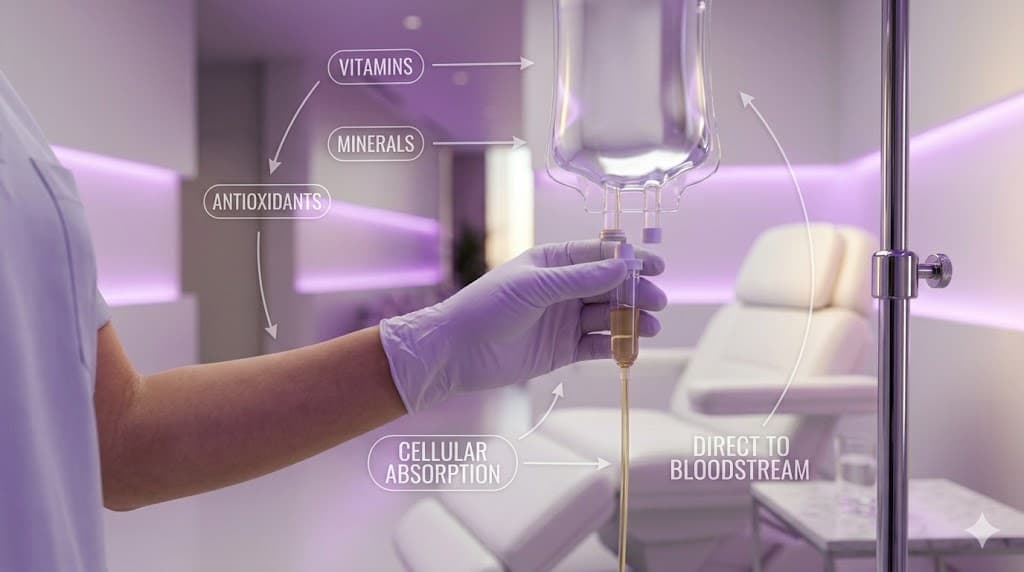
Intravenous therapy means giving fluids, medicines or nutrients directly into a vein, through a cannula, and it is one of the basic procedures of hospital medicine. Its use in wellness, for vitamins in people without a demonstrated deficiency, is a different use, with much weaker evidence but the same procedural risks.
The article separates the two uses, explains a session step by step and describes the possible complications openly.
IV therapy in medicine
In hospital, the intravenous route is used when a rapid effect or a precise dose is needed, or when the oral route does not work. A few examples with a clear indication:
- Fluids. The NICE guideline sums up their uses in five situations: resuscitation, routine maintenance, replacement of losses, correction of fluid redistribution, and reassessment.
- Intravenous thiamin in Wernicke's encephalopathy, where European guidelines note that even high oral doses may not be effective.
- Parenteral vitamin B12, usually intramuscular, in pernicious anaemia and other forms of malabsorption with severe deficiency.
- Intravenous iron for confirmed iron deficiency, when the oral route is not tolerated or not sufficient.
NICE also sets out a general principle: intravenous fluids should be prescribed and administered only by trained professionals who assess and monitor the patient.
IV therapy in wellness
Drips with vitamins, minerals or antioxidants for energy, recovery or immunity, in people without a disease that calls for them, are a different category. The reference formula is Myers' Cocktail, and the only placebo-controlled trial we verified found no statistically significant difference compared with placebo. Details in the article about Myers' Cocktail.
What can be said with certainty about the intravenous route is a matter of pharmacology: for some substances, such as vitamin C, the concentration reached in the blood is much higher than by mouth, where the body controls it tightly. A higher concentration does not, however, automatically mean a better clinical effect. The discussion of the evidence is in the article do vitamin IV drips actually work?.
How a session works
Preparation, what to eat beforehand and what to bring are described in the IV drip guide.
Intravenous is not the same as intramuscular
Not everything called “injectable” is a drip. The difference matters for how long it takes and for what is checked.
| Intravenous (drip) | Intramuscular (injection) | |
|---|---|---|
| Where it goes | directly into a vein | into a muscle, from which it is absorbed gradually |
| How long it takes with us | 30 minutes to two to three hours | about 10–15 minutes |
| Examples from our catalogue | Vitamin B complex, High-dose vitamin C 5000 mg, Complex B forte | Vitamin B12, Vitamin D 100,000 and 300,000 IU |
| Fluid added to the circulation | yes, the dilution solution | no |
We give injectable vitamin B12 and vitamin D only after a medical assessment, because they are used to correct a deficiency. A short injection does not mean a less important decision.
What risks it carries
IV therapy is a medical procedure and has known complications. A meta-analysis published in 2020, of 103 studies and almost 77,000 peripheral venous catheters, found that phlebitis and infiltration are the most common reasons a catheter has to be removed. The figures come from studies of peripheral venous catheters placed in hospitals and emergency departments, not from short wellness sessions, so they do not transfer directly. They do show, however, that these complications are common, not exceptions.
| Complication | What it means | What to watch for |
|---|---|---|
| Phlebitis | inflammation of the vein the cannula is in | redness, pain or a tender “cord” along the vein |
| Infiltration | the solution leaks out of the vein into the surrounding tissue | swelling, a cold feeling or pain at the cannula site |
| Allergic reaction | the body's response to a component of the solution | itching, hives, difficulty breathing, dizziness |
| Fluid overload | more fluid than the heart or kidneys can handle | difficulty breathing, swollen lower legs |
A few points that matter:
- Phlebitis occurred, in studies with a clear definition of it, in about 19% of catheters, and infiltration in about 14%.
- Allergic reactions are rare but not impossible, even with vitamins. In the LOVIT trial, with intravenous vitamin C in patients with sepsis, one serious anaphylaxis event was reported. For intravenous iron, the European Medicines Agency (EMA) requires administration only where trained staff and resuscitation facilities are immediately available — which is why we give iron infusions exclusively at the clinic.
- Fluid overload is the risk that makes the difference between patients. The NICE guideline recommends smaller volumes in older or frail people and in those with kidney impairment or heart failure, and difficulty breathing that appears during the infusion is a sign of possible overload.
If after the session you get spreading redness, a fever, increasing pain or difficulty breathing, let us know immediately and, if needed, call 112 (the emergency number).
Who needs to be careful or avoid it
A wellness drip is not suitable “for anyone, at any time”. The conversation at the assessment matters especially if:
- you have heart failure or kidney disease — the fluid volume and some substances, such as magnesium, call for caution;
- you have had an allergic reaction to an infusion or to one of its components;
- you are pregnant or breastfeeding;
- you have an acute infection with a fever — then the right place to go is your GP (family doctor);
- you take long-term treatments, including anticoagulants or medicines for the heart or kidneys.
No assessment made through an online form replaces the conversation with the doctor. Risks and contraindications are detailed on the page about IV drip safety.
How we work at Synerva
Protocols are supervised by an intensive care physician (anaesthesia & intensive care) and are given after a medical assessment, included in the price. All intravenous protocols, with composition, duration and price, are on the intravenous therapies page. Drips start at 250 RON, and intramuscular injections at 150 RON.
They can be given at the clinic or at home, where a travel fee is added: 100 RON in Bucharest, free for orders of 600 RON or more, and 150 RON in Ilfov, free for orders of 900 RON or more. Intravenous iron is given only at the clinic. If the conclusion of the assessment is that you do not need an infusion, we tell you. You can book an assessment.
Sources
For information only. It does not replace a medical consultation; the decision to administer rests with the doctor, after the assessment.
Frequently asked questions
- What is intravenous therapy?
- Giving fluids, medicines or nutrients directly into a vein, through a cannula. In hospital it is used for fluids, medicines and correcting certain deficiencies; in wellness, for vitamin and mineral drips in people without a disease that calls for them, where the evidence is weaker.
- How long does an IV therapy session take?
- For most of our protocols the drip takes 30–60 minutes. NAD+ protocols can take two to three hours, and the iron infusion, with the observation afterwards, about 1.5–2.5 hours. Add to this the assessment at the start.
- What risks does an IV drip carry?
- The most common are phlebitis, meaning inflammation of the vein, and infiltration, when the solution leaks into the surrounding tissue. Allergic reactions are rarer. In people with heart or kidney conditions, the volume of fluid can be a problem. That is why there is an assessment beforehand and supervision during the infusion.
- Who should not have vitamin drips?
- Caution is needed with heart failure, kidney disease, allergies to the components, pregnancy or breastfeeding, an acute infection with a fever and significant long-term treatments. The decision is made at the medical assessment, not from a form.
- Is a vitamin drip better than oral supplements?
- For some substances it reaches much higher blood concentrations. That does not automatically mean a better clinical effect. In people without a deficiency and without absorption problems, oral supplements are often enough.
- Can the drips be given at home?
- Yes, in Bucharest and Ilfov, except for intravenous iron, which is given only at the clinic. The travel fee is 100 RON in Bucharest (free from 600 RON) and 150 RON in Ilfov (free from 900 RON).
- What should I do if the drip site turns red after the session?
- Let us know. Redness that spreads, pain that increases or a fever need to be seen by a doctor. If you have difficulty breathing, call 112.
More in Guides
- Do vitamin IV drips actually work? An honest look at the evidence
It depends what for. Injectable vitamins are standard treatment in some deficiencies and absorption disorders, but for energy or immunity in healthy people the evidence is weak. What the studies show, how much placebo matters and what questions to ask a clinic before you pay.
- How often can you have vitamin IV drips — frequency, blood tests and the risk of excess
There is no frequency that suits everyone. The pace depends on the goal and, for vitamins that accumulate or for iron, on a confirmed deficiency. The documented risks of “more often”, what the studies show about repeated infusions and how courses are put together.
- How an IV drip at home works — step by step, costs and what is not done at home
What happens from booking until the nurse leaves with the medical waste, what you need to prepare at home, which protocols are not given at home and why, what the travel fee is and where we go in Bucharest and Ilfov.
- The hydration IV drip: when it helps, when oral rehydration is better and when it is an emergency
For most dehydration, the oral rehydration solution recommended by the WHO works. When the intravenous route makes sense, what the studies in athletes show, the signs that need emergency care and why heart and kidney conditions change the conversation.
SYNERVA services related to this article
Thinking of trying it?
We start with a medical assessment — we tell you which protocol makes sense for you and which doesn't. Published prices, no surprises.
Book an assessment