The hydration IV drip: when it helps, when oral rehydration is better and when it is an emergency
For most dehydration, the oral rehydration solution recommended by the WHO works. When the intravenous route makes sense, what the studies in athletes show, the signs that need emergency care and why heart and kidney conditions change the conversation.
English translation of content medically reviewed in Romanian by Dr. Claudiu Ruscu, intensive care physician (anaesthesia & intensive care)· Romanian text reviewed 13 September 2026
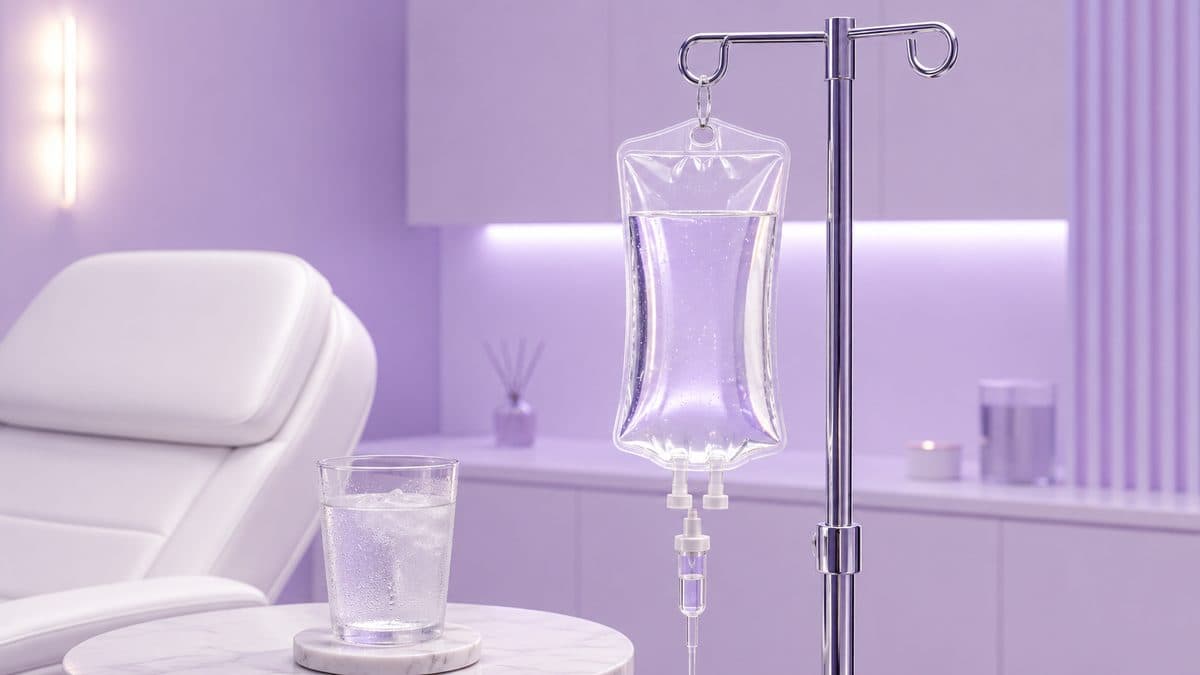
For mild or moderate dehydration, the first option is rehydration by mouth — water and, for losses through vomiting or diarrhoea, the oral rehydration solutions recommended by the World Health Organization (WHO). A hydration drip makes sense occasionally, when drinking is not tolerated or when you want supervised rehydration, and severe dehydration is not a case for a wellness drip but for the emergency department.
How to recognise dehydration
The UK National Health Service (NHS) lists the usual signs in adults:
- thirst, dry mouth, lips and tongue;
- headache, feeling light-headed, dizziness;
- dark yellow, strong-smelling urine and peeing less often;
- tiredness;
- sunken eyes.
Dehydration happens more easily after exposure to heat, heavy sweating during exercise, fever, drinking alcohol or in people taking diuretics. Babies, children and older people are more at risk.
Oral rehydration: the first option, with evidence
For diarrhoea, the WHO recommends oral rehydration solution (ORS): a mixture of clean water, salt and sugar that is absorbed in the small intestine and replaces the water and electrolytes lost. Intravenous rehydration is reserved for severe dehydration or shock. In pharmacies, these solutions come as a powder that you dissolve in water; the NHS recommends asking a pharmacist for advice on which to choose. If you feel sick, start with small sips.
The most solid head-to-head comparison comes from a Cochrane review (Hartling et al., 2006), in children with dehydration due to gastroenteritis: 17 trials, 1,811 participants. The results:
- there were no clinically important differences between oral and intravenous rehydration in weight gain or the duration of diarrhoea;
- the hospital stay was shorter in the oral rehydration group;
- phlebitis — inflammation of the vein — was more common with the intravenous route;
- in about 1 in 25 children, oral rehydration failed and a drip was needed.
The review is in children, so it does not automatically transfer to adults. It does show something important, though: the oral route, done properly, works for most people, and a drip comes with its own risks.
A drip after exercise: faster, but not necessarily better
A review in Sports Medicine (van Rosendal et al., 2010) looked at intravenous versus oral rehydration in athletes. Its conclusions:
- rehydration is faster with a drip, but the benefits are generally transient, with small differences in hydration markers;
- performance in the following bout of exercise did not improve more with one method than with the other;
- a drip bypasses the stimulation of the mouth and throat, which influences the sensation of thirst and the release of vasopressin.
A small study published in 2026, in active men cycling in the heat, even found better performance and lower body temperature when the fluids were drunk, compared with the same amount given intravenously.
Two practical points for people who do sport:
- Too much fluid is also a risk. The position statement of the US National Athletic Trainers' Association (NATA, 2017) warns that both under-hydration and over-drinking — with a risk of hyponatraemia — can compromise performance and health.
- Registered competitive athletes have a specific rule. The Prohibited List of the World Anti-Doping Agency (WADA) includes intravenous infusions or injections of more than 100 ml per 12 hours, except those legitimately received in hospital, during surgery or during clinical investigations; otherwise a therapeutic use exemption is needed. If you are an athlete subject to anti-doping testing, tell us beforehand.
When a hydration drip makes sense
Occasionally, after an assessment:
- when you have lost fluids after heat or exercise and cannot manage to drink enough;
- when nausea makes oral rehydration hard to tolerate, without any warning signs;
- when you prefer rehydration supervised by medical staff, at the clinic or at home.
It does not make sense as a routine for someone who drinks enough and feels well.
Signs that need emergency care, not a drip
Dehydration with signs of shock — call 112 (the emergency number) or go to the emergency department if, according to the NHS, you notice:- blue, grey, pale or blotchy skin or lips;
- skin that is cold to the touch;
- difficult or very fast breathing;
- confusion;
- unusual drowsiness or being difficult to wake.
- the person does not improve after 30 minutes of resting somewhere cool, with cooling and fluids;
- a very high temperature;
- hot skin that is no longer sweating;
- a fast pulse or fast breathing;
- confusion, lack of coordination;
- seizures or loss of consciousness.
Vomiting or diarrhoea that does not stop, especially in young children and older people, also belongs in the emergency department.
Who needs to be careful
A drip means volume added directly to the circulation. The NICE guideline on intravenous fluids in adults recommends smaller amounts for people who are older or frail, or who have kidney failure or heart failure, and specialist help when there is kidney, liver or heart impairment.
In practice: if you have heart failure, chronic kidney disease, swelling (oedema) or have been advised to restrict fluids, a wellness hydration drip is not a decision to make on your own. Tell us when you book; most of the time the answer will be that we do not give it.
How to rehydrate properly at home
For mild dehydration, without the signs above, the steps recommended by the NHS are simple:
If you exercise regularly, NATA recommends that fluid intake be tailored individually, based on how much you actually sweat in your training conditions — not on a fixed rule, which can lead to either too little or too much.
A drip comes into the discussion when these steps are not tolerated or not enough, and there are no warning signs.
What we give
The protocols in our catalogue, with the medical assessment included:
| Protocol | Composition | Duration | Price |
|---|---|---|---|
| Recovery | rehydration and electrolytes | about 30 min | 350 RON |
| Minerals & trace elements | magnesium, calcium, zinc, trace elements | about 30 min | 250 RON |
| Immunity Boost | vitamin C, B complex, minerals | about 60 min | 600 RON |
They are given at the clinic or at home, in Bucharest and Ilfov. Details on the hydration IV drip page; if the reason is a night of heavy drinking, also read what the hangover drip can and cannot do.
Sources
For information only. It does not replace a medical consultation. If there are warning signs, call 112.
Frequently asked questions
- Is a hydration drip better than water?
- It rehydrates faster, but in athletes the differences were transient and performance was no better than with fluids drunk by mouth. For most mild and moderate dehydration, the oral route works and is the first option.
- What is oral rehydration solution?
- A mixture of water, salt and sugar, in set proportions, recommended by the World Health Organization for dehydration due to diarrhoea. It is sold in pharmacies as a powder; the pharmacist can help you choose.
- When is dehydration an emergency?
- When there is cold, pale or bluish skin, fast or difficult breathing, confusion, unusual drowsiness, vomiting or diarrhoea that does not stop, or signs of heatstroke — hot skin that is not sweating, a very high temperature, seizures. Call 112.
- Who should not have a hydration drip?
- People with heart failure, kidney disease, oedema or a fluid restriction need a specialist assessment, and as a rule we do not give a wellness drip in these situations. The NICE guideline also recommends caution in older or frail people.
- Can I have a hydration drip if I am a registered competitive athlete?
- Be careful: the WADA list prohibits intravenous infusions of more than 100 ml per 12 hours outside hospital treatment, surgery or clinical investigations, without a therapeutic use exemption. Tell us before you book.
- How much does a hydration drip cost and how long does it take?
- The Recovery protocol (rehydration and electrolytes) costs 350 RON and takes about 30 minutes, with the assessment included. Minerals & trace elements costs 250 RON, and Immunity Boost 600 RON, about 60 minutes.
More in Guides
- Why am I not losing weight on Mounjaro? What to check before you change anything
The scales have not moved for a few weeks and your first reaction is to think the treatment does not work for you. Most of the time the explanation is something else, and several of the possibilities can be checked at home in five minutes. What the studies show about the real pace of weight loss, and what exactly is worth discussing with the doctor who prescribed your treatment.
- Hydration and food intake in the first months of injectable treatment
In the first months, the feeling of fullness comes much earlier and thirst often goes unnoticed. Fluid intake drops without anyone deciding it. How much you actually need, how to tell that you are not managing, what works at home and, at the end, when medical support makes sense.
- Weight-loss injections: what you should know before you start
"Weight-loss injections" is the popular name for a class of prescription medicines. What they actually are, how they act, how much weight is lost in the clinical trials, which side effects are common, who is not a candidate and which questions are worth asking at the consultation.
- Side effects of weight-loss injections: what is common and when to call the doctor
Most side effects are digestive, appear at the start and ease. A few, however, are not something to wait out. What the approved documents report by frequency, what each category means in practice and which signs call for immediate contact with the doctor.
SYNERVA services related to this article
Thinking of trying it?
We start with a medical assessment — we tell you which protocol makes sense for you and which doesn't. Published prices, no surprises.
Book an assessment