How an IV drip at home works — step by step, costs and what is not done at home
What happens from booking until the nurse leaves with the medical waste, what you need to prepare at home, which protocols are not given at home and why, what the travel fee is and where we go in Bucharest and Ilfov.
English translation of content medically reviewed in Romanian by Dr. Claudiu Ruscu, intensive care physician (anaesthesia & intensive care)· Romanian text reviewed 13 September 2026
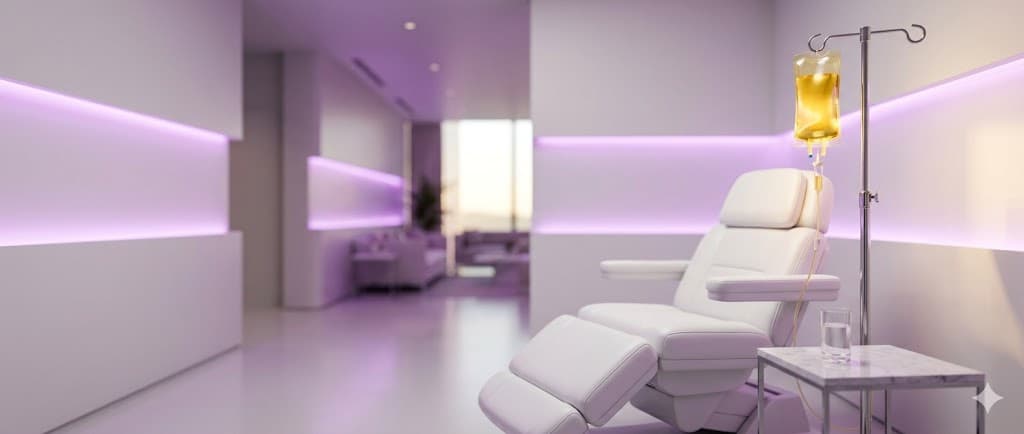
An IV drip at home is given in six steps: booking, medical assessment, placing the cannula, the infusion, monitoring, and the nurse leaving with all the medical waste. Not every protocol can be given at home — intravenous iron, for example, is given only at the clinic, where emergency equipment and observation after the infusion are available.
Step 1: booking
You choose a time slot through the booking form, by phone or on WhatsApp. We work every day, between 09:00 and 20:00.
An appointment means a time agreed together, not an estimated arrival time. We do not promise a number of minutes, because travel time depends on traffic. For the same day, call us and we will tell you which slot is free in your area.
At the same time we discuss the protocol you have in mind. If it is one that is not given at home, we tell you from the start, not after the nurse is at your door.
Step 2: the medical assessment
Before any infusion, your goal, medical history, current medication and any contraindications are discussed, and your blood pressure and pulse are measured on the spot. The assessment is included in the price of the protocol.
The assessment can also have an outcome you do not expect: that the drip is not right for you at the moment. Some situations call for caution with intravenous fluids — kidney or heart conditions and older age are the examples given by the NICE guideline on intravenous fluids. If that is the case, we do not administer it.
Step 3: placing the cannula
The nurse disinfects the area and places a cannula — a thin plastic tube inserted into a vein — usually on the forearm or the back of the hand. It feels like a short prick.
If your veins are hard to find, tell us when you book. It helps to drink water in the hours beforehand and to keep warm. If the cannula cannot be placed comfortably and safely, we do not keep trying with repeated pricks, and we discuss the right alternative, including coming to the clinic.
Step 4: the infusion
The solution runs in slowly while you lie down or sit. You can read, work or talk on the phone. Infusion times, from our catalogue:
| Protocol | Duration | Price |
|---|---|---|
| Minerals & trace elements | about 30 min | 250 RON |
| Recovery (rehydration and electrolytes) | about 30 min | 350 RON |
| Vitamin B complex | about 30 min | 300 RON |
| Magnesium IV drip | about 40 min | 250 RON |
| Complex B forte | about 45 min | 650 RON |
| Immunity Boost | about 60 min | 600 RON |
| NAD+ 250 mg | 120–180 min | 1,250 RON |
Long protocols, such as NAD+, take hours not for a commercial reason, but because the slow rate is part of how well the infusion is tolerated.
Step 5: monitoring
The nurse stays with you throughout the infusion, watches how you feel and adjusts the rate if needed. At the end they remove the cannula, apply a dressing and stay a few more minutes for observation. You can go back to your activities straight away.
Step 6: leaving — together with the waste
The needles, giving sets and other used materials do not stay in your bin. The World Health Organization classifies intravenous needles and infusion sets as sharps waste, a category of hazardous medical waste with a risk of injury and infection. The nurse collects them in a dedicated container and takes them away.
What the nurse brings and what you prepare
The nurse comes with:
- sterile, single-use materials: cannula, giving set, disinfectant, dressing;
- the solution prepared for the agreed protocol;
- a drip stand or a system for hanging the bag;
- a blood pressure monitor and a pulse oximeter;
- an emergency kit;
- the container for medical waste.
You prepare:
- a place where you can sit comfortably for the length of the protocol — a bed, sofa or armchair;
- a table or a socket nearby, if you want to work;
- a light meal 1–2 hours beforehand, not an empty stomach;
- a list of your medicines and recent blood tests, if you have them;
- clothes with loose sleeves that are easy to roll up.
What is NOT done at home and why
Intravenous iron. All intravenous iron preparations can cause severe hypersensitivity reactions. The European Medicines Agency (EMA) requires them to be given only where there are staff trained to manage anaphylactic reactions and resuscitation facilities immediately available, with the patient observed for at least 30 minutes after each administration. That is why the iron infusion is given exclusively at the clinic, with continuous monitoring, and only on the basis of blood tests. Cerebrolysin. It is a prescription-only medicine, given at the clinic, with monitoring throughout the infusion, on the basis of a documented neurological diagnosis. Gerovital H3. It is given intramuscularly, at the clinic, with observation afterwards, and the first injection requires a procaine sensitivity test at a separate visit. Any acute situation. Vomiting that does not stop, confusion, chest pain or difficulty breathing are not reasons for a drip at home. Call 112 (the emergency number).How much an IV drip at home costs
The price of the protocol is the same as at the clinic. Only the travel fee is added:
| Area | Travel fee | Free for |
|---|---|---|
| Bucharest | 100 RON | orders of 600 RON or more |
| Ilfov | 150 RON | orders of 900 RON or more |
A few worked examples:
- Recovery in Bucharest: 350 RON + 100 RON travel = 450 RON.
- Immunity Boost in Bucharest: 600 RON, free travel.
- Immunity Boost in Ilfov: 600 RON + 150 RON = 750 RON.
- NAD+ 250 mg anywhere in the area covered: 1,250 RON, free travel.
We confirm the final amount when you book, before anyone sets off to you. All protocol prices are on the prices page.
Where we go
All 6 sectors (districts) of Bucharest and the towns and villages of Ilfov around the capital — among them Pipera, Voluntari, Otopeni, Popești-Leordeni, Chiajna and Bragadiru. If you are not sure we cover your address, ask us. The clinic is in Sector 1, near Piața Romană.
Clinic or home: how to choose
The protocol, the dose and the monitoring are the same in both places; only the setting changes.
- At home you gain the travel time and the comfort of your own space, and after the drip you get straight back to what you were doing. It suits short, well-tolerated protocols that do not need special equipment.
- At the clinic you have emergency equipment a few steps away and a setting in which the preparations that require it can also be given.
- The clinic may be the better choice if you have had reactions to previous drips or if your veins are very difficult to access — we discuss this when you book.
If you do not know what to choose, tell us which protocol you have in mind and we will explain when you book.
Safety, in brief
- The infusion is given by medical staff, after an assessment, never “on request”.
- Materials are sterile and single-use.
- Protocols that need emergency equipment a few steps away stay at the clinic.
- Medical supervision is provided by an intensive care physician (anaesthesia & intensive care) — see the team.
- We do not recommend or support self-administration of injections or drips.
All the details about the service, including the updated price table, are on the page about the IV drip at home in Bucharest and Ilfov.
Sources
For information only. Whether an infusion can be given at home is decided at the medical assessment.
Frequently asked questions
- How is an IV drip given at home, in short?
- You book a time, the nurse comes and does the assessment (history, medication, blood pressure, pulse), places the cannula, gives the drip and supervises you throughout. At the end they remove the cannula, stay a few more minutes for observation and leave, taking the medical waste with them.
- How much is the travel fee?
- 100 RON in Bucharest, free for orders of 600 RON or more, and 150 RON in Ilfov, free from 900 RON. The price of the protocol is the same as at the clinic, with the medical assessment included.
- How quickly can you get to me?
- We work by appointment, at a time agreed together, between 09:00 and 20:00, every day. We do not promise a number of minutes, because travel depends on traffic; for the same day, call us and we will tell you which slot is free in your area.
- What do I need to prepare at home?
- A comfortable place to sit for the length of the protocol, a light meal 1–2 hours beforehand, clothes with loose sleeves and, if you have them, a list of your medicines and recent blood tests. The nurse brings the sterile materials, the solution, the blood pressure monitor and the emergency kit.
- Do you give iron infusions at home?
- No. The European Medicines Agency requires intravenous iron to be given only where there are staff trained in anaphylaxis and immediate resuscitation facilities, with observation for at least 30 minutes afterwards. We give it exclusively at the clinic, on the basis of blood tests.
- Which areas do you cover?
- All 6 sectors of Bucharest and the towns and villages of Ilfov around the capital, including Pipera, Voluntari, Otopeni, Popești-Leordeni, Chiajna and Bragadiru.
- What happens to the needles and the giving set afterwards?
- They leave with the nurse, in a dedicated container. Intravenous needles and infusion sets are sharps medical waste and do not go in household rubbish.
- Can I have the drip at home if my veins are hard to find?
- In most cases, yes — tell us when you book. If the cannula cannot be placed comfortably and safely, we do not keep trying, and we discuss the right alternative, including coming to the clinic.
More in Guides
- The hydration IV drip: when it helps, when oral rehydration is better and when it is an emergency
For most dehydration, the oral rehydration solution recommended by the WHO works. When the intravenous route makes sense, what the studies in athletes show, the signs that need emergency care and why heart and kidney conditions change the conversation.
- Why am I not losing weight on Mounjaro? What to check before you change anything
The scales have not moved for a few weeks and your first reaction is to think the treatment does not work for you. Most of the time the explanation is something else, and several of the possibilities can be checked at home in five minutes. What the studies show about the real pace of weight loss, and what exactly is worth discussing with the doctor who prescribed your treatment.
- Hydration and food intake in the first months of injectable treatment
In the first months, the feeling of fullness comes much earlier and thirst often goes unnoticed. Fluid intake drops without anyone deciding it. How much you actually need, how to tell that you are not managing, what works at home and, at the end, when medical support makes sense.
- Weight-loss injections: what you should know before you start
"Weight-loss injections" is the popular name for a class of prescription medicines. What they actually are, how they act, how much weight is lost in the clinical trials, which side effects are common, who is not a candidate and which questions are worth asking at the consultation.
SYNERVA services related to this article
Thinking of trying it?
We start with a medical assessment — we tell you which protocol makes sense for you and which doesn't. Published prices, no surprises.
Book an assessment