Detox: what it really means and what an IV drip can do
Detox is a word used everywhere — but what can an IV drip do, and what can it NOT do? How the body detoxifies itself, where glutathione and NAC help, and where it is just marketing.
English translation of content medically reviewed in Romanian by Dr. Claudiu Ruscu, intensive care physician (anaesthesia & intensive care)· Romanian text reviewed 23 June 2026
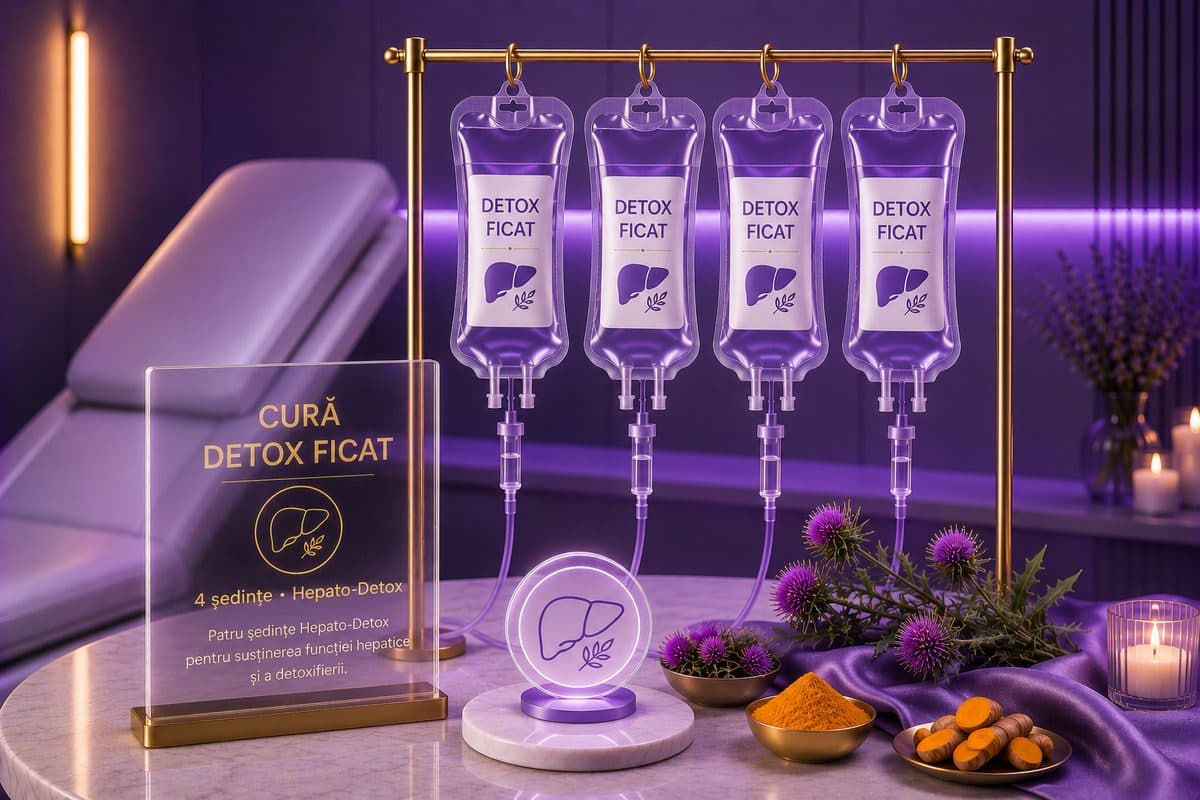
“Detox” — what it actually means
The word “detox” is used everywhere: teas, diets, drips. The biological reality is simpler and more reassuring — your body already has a very efficient detoxification system. The liver and kidneys continuously filter and remove the substances it does not need. You do not need a “cure” to start this process; it runs non-stop.
What a drip does NOT do
Let us be honest from the start: no drip “flushes out toxins” or fixes an unbalanced lifestyle. If you see promises such as “removes all toxins” or “resets your body”, that is marketing, not medicine. A drip does not replace the liver and does not make up for lack of sleep, excess alcohol or a consistently poor diet.
Where it can help, all the same
What a liver-type/detox protocol can concretely do is support normal liver function, by supplying substances the body already uses in its own processes:
- Glutathione — the antioxidant produced naturally by the liver, involved in neutralising oxidative stress; given intravenously, it is the basis of the glutathione IV drip
- NAC (N-acetylcysteine) — a precursor of glutathione
- Hydration and vitamins — support for your general condition
The benefit is “support”, not “miraculous cleansing”. It is an important nuance.
Ornithine aspartate: what liver support with a pharmacological basis actually looks like
It deserves a section of its own, because it is the most searched-for “liver” product in Romania and because it illustrates exactly the difference between marketing and medicine.
Ornithine aspartate (L-ornithine L-aspartate, sold in Romania as Hepa-Merz) is not a “detox”. It is a medicine with a precise target: ammonia. Ornithine enters the urea cycle, the pathway by which the liver turns ammonia into urea, which the kidneys can excrete; aspartate takes part in the synthesis of glutamine, the second pathway by which the body binds ammonia. The aim is to lower blood ammonia. The real indication is not tiredness after the holidays. It is hepatic encephalopathy, latent or overt, which occurs when a liver with severely impaired function — usually in cirrhosis — can no longer detoxify ammonia, and it reaches the brain. It is given orally, as granules, or intravenously, as a solution for infusion, in both cases to a patient with an established diagnosis. What the data say, honestly. The 2018 Cochrane review found a possible beneficial effect on mortality compared with placebo, but rated the evidence as very low quality, and compared with other active treatments it showed no clear advantage. In other words: a plausible, well-described mechanism, a legitimate indication, but an evidence base more fragile than the product's popularity suggests. It also has contraindications — severe kidney failure, among others.Why the distinction matters
A treatment with a pharmacological basis has three things a “detox cure” never has: a measurable target (here, serum ammonia), a diagnosis that justifies the intervention and a way of checking whether it worked.
In a healthy person, ammonia is not raised. There is nothing to lower. That, in essence, is the whole difference between a medicine used in liver disease and a drip chosen for the feeling of a “reset”.
We do not administer ornithine aspartate. We explain it here because it is searched for massively and because the people looking for it often have a real liver problem — and that needs investigations and a gastroenterologist or hepatologist, not a wellness drip. If you have abnormal liver tests, jaundice, ascites or confusion, the right path is to a doctor, not to an IV drip clinic.Who it makes sense for
- People with a demanding pace of life who want a bioavailable antioxidant supply
- After periods of excess (heavy meals, occasional alcohol)
- Those who are complementing — not replacing — rest, hydration and diet
At SYNERVA
The liver support IV drip is built around glutathione and NAC — the Liver support (glutathione + NAC) protocol combines both, and for sustained supply there is also the four-session course. Each starts with a short medical assessment.
We will tell you honestly when it makes sense and when the best “detox” is simply more sleep and less alcohol — free and more effective than any drip. And we will tell you just as honestly when the problem goes beyond what a drip can do and you need a specialist consultation.
---
Sources
This article is for information only and does not replace a medical consultation. Suspected liver disease is investigated, not treated with supportive drips.
Frequently asked questions
- What is Hepa-Merz and why don't you give it?
- The active substance is L-ornithine L-aspartate, a medicine with a precise target: lowering serum ammonia. Its indication is hepatic encephalopathy in cirrhosis, in a patient with an established diagnosis and monitoring — not liver support in a healthy person. We do not give it; anyone with a real liver problem needs a gastroenterologist or hepatologist.
- Does a drip really detox the liver?
- It does not flush out toxins. The liver and kidneys already do that continuously. Glutathione and NAC can support the antioxidant mechanisms involved — the benefit is support, not cleansing. No drip makes up for excess alcohol or lack of sleep.
- What is the difference between a detox and documented liver support?
- Three things: a measurable target, a diagnosis that justifies the intervention and a way of checking whether it worked. In a healthy person ammonia is not raised, so there is nothing to lower.
- What should I do if my liver tests are abnormal?
- Investigate the cause. Raised transaminases, jaundice, ascites or confusion are reasons for a specialist consultation and investigations, not for a supportive drip. We tell you this even if it means you leave without booking anything.
More in Guides
- Cerebrolysin: what it is, how it is given and what the studies actually show
Cerebrolysin is a prescription medicine, not a supplement and not a “memory booster”. What an ampoule contains, its licensed indications, why doses above 10 ml are given only as a diluted infusion, and what the Cochrane reviews found — including the uncomfortable part.
- Cerebrolysin — the leaflet in plain English: dosage, dilution, administration
A medicine's leaflet is written for the doctor, not the patient. We translate the part that matters: what an ampoule contains, which dose is given for which indication, why anything above 10 ml is given only as a diluted infusion, and what must not be mixed into the infusion bag.
- How much a Cerebrolysin infusion costs: what the price includes and what a course costs
At Synerva, a session costs 300 RON and includes the medical consultation, the 10 ml ampoule, the infusion and monitoring. What that means for a 10–20-day course, and what needs settling before you book.
- TAD 600 and glutathione in ampoules — what it is, what the leaflet says, what to know beforehand
Anyone searching for "glutathione ampoules" quickly lands on TAD 600. We explain what the product contains, which indications the manufacturer attributes to it and where it is actually sold in Romania — because the answer to the last question matters more than the first two.
SYNERVA services related to this article
Thinking of trying it?
We start with a medical assessment — we tell you which protocol makes sense for you and which doesn't. Published prices, no surprises.
Book an assessment