Resveratrol — which benefits are proven, its contraindications and the medicines it interacts with
Resveratrol looks good in the laboratory and in animals. In humans, studies are few, small and almost all oral, and clinical data on intravenous use are missing. What is known for sure, what is not, and the part that matters most: interactions.
English translation of content medically reviewed in Romanian by Dr. Claudiu Ruscu, intensive care physician (anaesthesia & intensive care)· Romanian text reviewed 13 September 2026
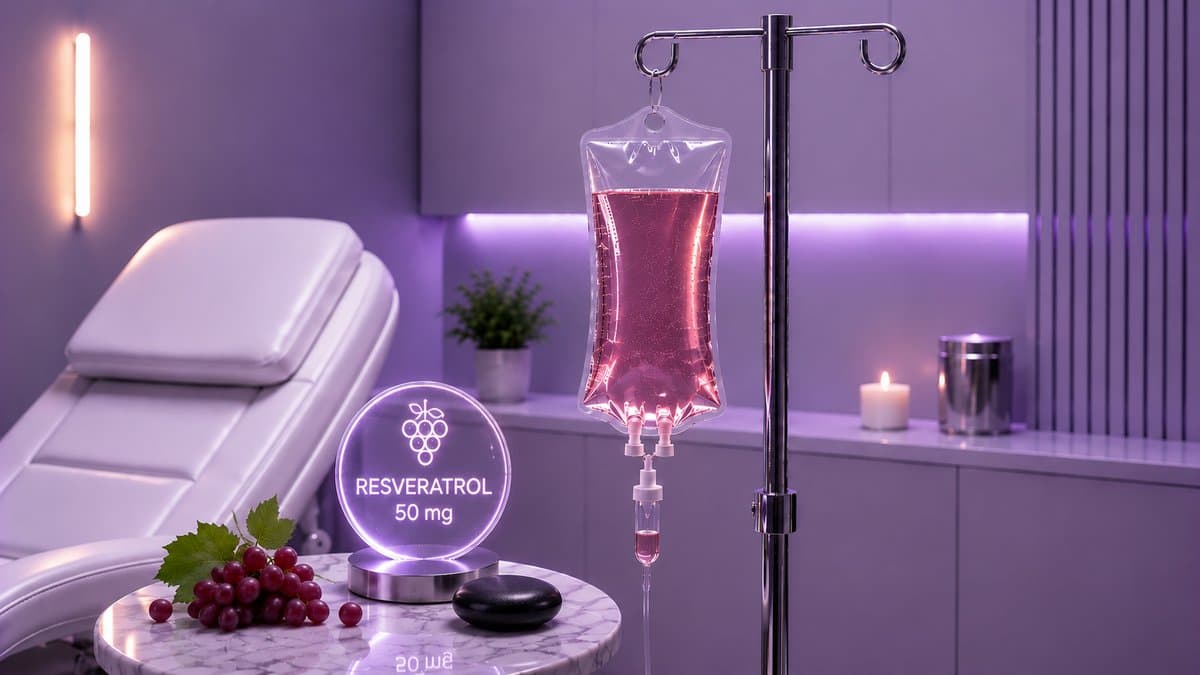
Resveratrol has interesting effects in laboratory and animal studies, but in humans the evidence is scarce, small-scale and almost all oral — and clinical studies of intravenous use at usual doses practically do not exist. The real precautions are interactions with anticoagulants, with antiplatelet medicines and with medicines metabolised by the liver; it is not given in pregnancy or breastfeeding.
What resveratrol is
A polyphenol from the stilbene group, found in grape skins, red wine, peanuts and, in high concentration, in the root of Polygonum cuspidatum (Japanese knotweed) — the source most often used for commercial products. The form studied is trans-resveratrol.
It became famous from two directions: the discussion about the "French paradox" and animal research on sirtuins, enzymes involved in the cell's response to calorie restriction. Both generated a great deal of enthusiasm and, so far, few confirmations in humans.
What studies show — by level of evidence
It is worth separating what is known by type of study, because this is exactly where most articles mix things up.
In the laboratory and in animals. Antioxidant, anti-inflammatory and metabolic effects, described in a large number of papers. The problem, known for a long time: many of the effects appear at concentrations that are hard to reach in the human body. In humans, by mouth — high absorption, very low bioavailability. A 2004 pharmacokinetic study in six volunteers showed that at least 70% of an oral dose of 25 mg is absorbed, but only traces of unchanged resveratrol reach the plasma, below 5 ng/ml. The rest is converted almost immediately, in the gut and the liver, into sulphates and glucuronides.A 2007 phase I study went up to 5 g in a single oral dose, in healthy volunteers. The peak concentration of resveratrol averaged 2.4 µmol/L, and the metabolites had an exposure up to 23 times higher than the parent molecule. The authors note that the effects seen on cells in the laboratory require at least 5 µmol/L — so even a very large oral dose does not reach them.
In humans, clinical results. The 2020 Cochrane review of resveratrol in type 2 diabetes found three randomised studies, with 50 participants in total, oral doses between 10 and 1,000 mg a day, for 4–5 weeks. The effect on glycated haemoglobin and blood glucose was neutral, with very low certainty of evidence, and no study measured outcomes that matter in the long term.The honest conclusion: promising in the laboratory, clinically unproven in humans.
And the intravenous route?
This has to be said directly: we found no clinical studies evaluating resveratrol given intravenously, at usual doses, for any clinical outcome in humans. The only intravenous human data we identified come from the 2004 pharmacokinetic study, which used a tracer dose of 0.2 mg to measure the path of the molecule — not an effect.
In theory, the intravenous route bypasses the gut, so a larger share of unchanged resveratrol reaches the circulation. But the liver still metabolises it rapidly, and the fact that a concentration rises does not mean a benefit appears. These are two different claims, and for the second there are no data.
We do not extrapolate oral results to an IV drip and we do not extrapolate results on cells to people. Any text promising "longevity" or "rejuvenation" from intravenous resveratrol makes both leaps at once.
Safety: what is known
In healthy people taking no other treatment, oral resveratrol has generally been well tolerated. In the 2007 phase I study, single doses of up to 5 g produced no serious adverse events, and the 2012 review describes the same good tolerance in healthy volunteers not taking other medicines.
Two points change the picture, however. The first: "healthy volunteers taking no other medicines" does not describe most people over 40 who are interested in resveratrol. The second: good tolerance by mouth says nothing directly about the intravenous route, for which there is no comparable body of data.
That is why the safety discussion does not stop at "it is a natural compound". It moves on to the more useful question: what else are you taking?
Interactions — the most important part
If you remember only one thing from this whole article, let it be this.
Liver enzymes (CYP). In a study of 42 healthy volunteers, resveratrol taken by mouth, 1 g a day for four weeks, inhibited the activity of CYP3A4, CYP2D6 and CYP2C9 and induced CYP1A2. These are the enzymes that metabolise a very large share of commonly used medicines — from anticoagulants such as warfarin (CYP2C9) to some statins, antidepressants, beta-blockers or immunosuppressants.A review of the interaction potential reached the same conclusion: the risk is real, especially at high doses, and whether the interactions produce clinically significant effects in patients taking other medicines is not yet known. "Not known" does not mean "safe".
Blood clotting. On human platelets, in the laboratory, trans-resveratrol inhibits platelet aggregation in a dose-dependent way. The relevance in humans has not been quantified, but the direction is the same as that of blood-thinning medicines.In practice, the precaution applies to:
- anticoagulants — warfarin, acenocoumarol, direct oral anticoagulants;
- antiplatelet medicines — aspirin, clopidogrel and others;
- non-steroidal anti-inflammatory drugs taken regularly;
- known clotting disorders or unexplained bleeding;
- planned surgery or dental surgery;
- medicines with a narrow therapeutic window, where a small change in concentration matters.
The interaction studies used oral doses of the order of grams, while a 50 mg IV drip produces a different exposure, which nobody has measured in this context. That is precisely why we draw no conclusions either way and ask for the complete list of your medicines before any administration.
Pregnancy and breastfeeding
There are no human safety data for resveratrol at supplement doses in pregnancy or breastfeeding, let alone for the intravenous route. We do not give it during these periods, and we do not recommend it as a supplement either without the agreement of your treating doctor.
When we do not give it, or postpone the decision
- pregnancy, breastfeeding or possible pregnancy;
- anticoagulant or antiplatelet treatment — the conversation starts with the doctor who prescribed it;
- clotting disorders or upcoming surgery;
- significant liver or kidney disease;
- known hypersensitivity;
- people under 18.
Questions to ask before any resveratrol IV drip
Wherever you go, a clear answer to these is a good sign:
How we work
We have a single protocol: Resveratrol IV drip 50 mg — 900 RON, lasting about 60 minutes, after a medical assessment. At the assessment, the first question is not "what is your goal" but "what medicines are you taking". If you take an anticoagulant, the answer may be no, and that is a normal outcome of the assessment, not a failure.
We do not present it as a treatment for any disease, we do not promise longevity effects and we do not recommend it in place of a prescribed treatment. Details of the protocol: resveratrol IV drip. If you do not yet know what you might need, the right conversation starts with the medical assessment.
Sources
For information only. It does not replace a medical consultation; the decision to administer and the check for interactions rest with the doctor, after an assessment.
Frequently asked questions
- What benefits of resveratrol are proven?
- In humans, no clinical benefit has been convincingly demonstrated. Antioxidant and metabolic effects are described in the laboratory and in animals, but the 2020 Cochrane review on type 2 diabetes found only three small studies, with a neutral effect on blood glucose and very low certainty.
- Is resveratrol absorbed when taken by mouth?
- It is well absorbed, but converted almost immediately into metabolites. In a study with 25 mg by mouth, at least 70% was absorbed, yet only traces of unchanged resveratrol reached the plasma. Even 5 g doses do not reach the concentrations used in studies on cells.
- Are there studies of intravenous resveratrol?
- We found no clinical studies evaluating intravenous resveratrol, at usual doses, for a clinical outcome in humans. The only intravenous human data we identified use a tracer dose of 0.2 mg, for pharmacokinetic measurements.
- Can I take resveratrol if I am on anticoagulants?
- Not without the agreement of the doctor who prescribed your treatment. In the laboratory, resveratrol inhibits platelet aggregation and, at high oral doses, inhibits the enzyme CYP2C9, which metabolises warfarin. The same caution applies to antiplatelet medicines such as aspirin or clopidogrel.
- Which other medicines can it interact with?
- Medicines metabolised through CYP3A4, CYP2D6, CYP2C9 and CYP1A2 — a very broad category that includes some statins, antidepressants, beta-blockers and immunosuppressants. That is why we ask for the complete list of your medicines before any administration.
- Can resveratrol be taken in pregnancy?
- There are no human safety data for supplement doses in pregnancy or breastfeeding. We do not give it during these periods.
- How much does the resveratrol IV drip cost?
- At Synerva, the resveratrol 50 mg protocol costs 900 RON and takes about 60 minutes, after a medical assessment. The assessment may also result in a recommendation not to have it, for example if you take anticoagulants.
More in Guides
- Alpha-lipoic acid — contraindications, side effects and what the studies actually show
Alpha-lipoic acid has a single absolute contraindication in the leaflet for the injectable form, but several precautions that really matter: hypoglycaemia in people taking diabetes medicines, a rare autoimmune syndrome and reactions to the infusion. Plus what the ALADIN and SYDNEY trials say — and for whom.
- Amino acid infusions — from parenteral nutrition in hospital to the wellness IV drip
The same name covers two very different things: feeding a patient who cannot eat through a vein, and an IV drip for general wellbeing. What is known about each, who should not receive them and why the difference matters.
- Vitamin therapy — what it means, when it makes sense and why blood tests come first
Almost anything is sold as "vitamin therapy", from a multivitamin to an hour-long IV drip. What the term means, in which situations it has a clear medical basis and why, for most deficiencies, the tablet remains the first option.
- Brain fog after 40 — which causes to check first and what an IV drip does not fix
You lose words, struggle to concentrate, think "through cotton wool". "Brain fog" is not a diagnosis, but it often has causes that can be found. What gets checked, in what order, with whom — and why the first step is not a supplement or an IV drip.
SYNERVA services related to this article
Thinking of trying it?
We start with a medical assessment — we tell you which protocol makes sense for you and which doesn't. Published prices, no surprises.
Book an assessment