NAD supplements or IV drip — what pharmacy products actually contain
The most useful thing you can learn before buying a "NAD+" supplement: it almost certainly does not contain NAD+. What the products people search for in Romania really contain, the legal status of their ingredients in the EU and when the intravenous route makes sense.
English translation of content medically reviewed in Romanian by Dr. Claudiu Ruscu, intensive care physician (anaesthesia & intensive care)· Romanian text reviewed 13 September 2026
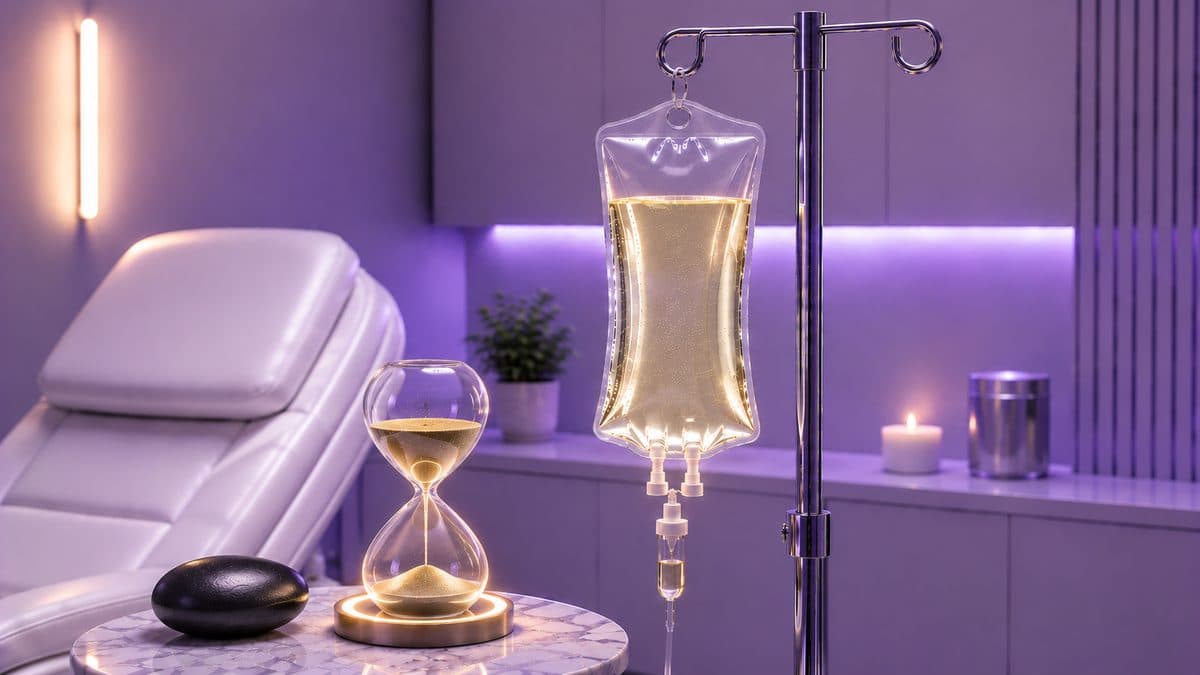
If you have searched for "NAD supplement" or "NAD Farmacia Tei" (Farmacia Tei is a large Romanian pharmacy chain), you have seen boxes with NAD+ written in large letters. The first useful thing to know is that, in most cases, there is no NAD+ inside them.
What the products actually contain
We checked the composition declared by the manufacturers for the two products searched for most often in Romania (September 2026):
| Product | What it contains, as declared |
|---|---|
| Therapium NAD+ | NMN (nicotinamide mononucleotide) and PQQ (pyrroloquinoline quinone) |
| Herboxa NAD+ | Nicotinamide riboside (Niagen), ubiquinol (CoQ10), resveratrol, BioPerine |
Neither contains NAD+. They contain precursors — molecules from which the body makes its own NAD+.
It is not a scam, it is a naming convention: the name describes what the product aims to raise, not what is in the capsule. But if you do not know that, you compare different things believing they are the same.
Why NAD+ is not put directly into a capsule
Because it would not do much good. NAD+ is a large molecule, unstable in the digestive tract, which does not get through intact. It would be broken down before absorption — which is why the industry works with precursors, which are smaller, more stable molecules.
That is also the reason intravenous administration exists: it bypasses the problem altogether.
The legal status of the ingredients in the EU — a real difference
Here is a distinction worth knowing, because it is a matter of regulation, not marketing:
Nicotinamide riboside chloride (Niagen, the ingredient in Herboxa) is authorised as a novel food in the European Union — by Commission Implementing Regulation (EU) 2020/16 of 10 January 2020, as a source of niacin in food supplements for adults. Its use was later extended. NMN (the ingredient in Therapium) has a different status. In May 2026, EFSA issued a favourable safety opinion for synthetic β-NMN, up to 300 mg a day, in adults, excluding pregnant and breastfeeding women. But the EFSA opinion is not the authorisation: as of the date of this article, the Commission has not issued the implementing act, so NMN is not yet authorised as a novel food in the EU.We are not saying anyone is breaking any rule — we are stating the status, with the date and the source. The situation may change, and probably will; check if you are reading this article later.
What the evidence shows for each route
Oral precursors. Human studies show that nicotinamide riboside raises NAD+ levels measurable in the blood. That has been demonstrated. What happens next — consistent clinical effects — is much less clear. The intravenous route. It bypasses digestion: the dose arrives in full and predictably. But the clinical evidence in humans for NAD+ infusions is limited, and we do not claim otherwise.In other words, neither route has a body of evidence that would justify promises. What differs is predictability, not certainty of the result.
Oral precursors: what the studies actually found
The claim "it raises NAD+" rests on real studies. The claim "and so you feel different" — much less so:
| Study | What was given | What was found |
|---|---|---|
| The first human pharmacokinetic study (2016) | nicotinamide riboside, single doses of 100, 300 and 1,000 mg | dose-dependent increases in the blood NAD+ metabolome |
| Healthy middle-aged and older adults (2018) | nicotinamide riboside, 6 weeks | well tolerated, NAD+ metabolism stimulated; functional effects — only signals to be checked |
| 12 older men (2019) | nicotinamide riboside 1 g a day, 21 days | the muscle NAD+ metabolome rose, with no change in the energy capacity of the mitochondria |
| 40 men with obesity (2018) | nicotinamide riboside 2 g a day, 12 weeks | safe, but no effect on insulin sensitivity, energy expenditure or body composition |
| Postmenopausal women with prediabetes and excess weight (2021) | NMN, 10 weeks | muscle insulin sensitivity increased |
The pattern is the same everywhere: the biochemical target is reached, the clinical result is not consistent. One study finds an effect; another, on a similar outcome, finds nothing. A 2026 systematic review of 33 human intervention studies reached exactly this conclusion: precursors consistently raise NAD+ metabolites and are generally well tolerated, but the functional and metabolic effects are heterogeneous and often null.
A detail worth knowing when you read these studies: some of them were sponsored by the ingredient manufacturers or have authors with declared interests in them. That does not invalidate them, but it is one more reason to wait for independent confirmation.
Nothing in the table is a reason to take a supplement for a medical problem. These are research studies, not indications.
The IV drip: what is known about NAD+'s path once it enters the vein
"It reaches the circulation in full" is true. But in full in the circulation does not mean it stays there.
Human data on what happens to NAD+ given directly into a vein come, essentially, from a single pilot study with a six-hour infusion. The result surprised even the authors: in the first two hours, the plasma NAD+ level did not rise at all — the molecule was taken up from the blood rapidly and completely. Changes appeared only afterwards, and by six hours urinary excretion of NAD+ and of one of its breakdown products, methylnicotinamide, had increased.
Where exactly it ends up and what it does in the tissues — we do not know. And the 2026 review found no study with clinical outcomes for intravenous NAD+ for longevity or general wellbeing.
The comparison, in a single table
| Oral supplement with precursors | NAD+ IV drip | |
|---|---|---|
| What you get | NR or NMN — precursors | NAD+ itself |
| Evidence that it affects NAD+ in humans | several randomised studies | one pilot pharmacokinetic study |
| Evidence of clinical effect | heterogeneous, often null | no study with clinical outcomes |
| Unwanted effects described | generally well tolerated in studies | nausea, chest pressure, raised heart rate if the rate is too fast |
| Where and how | at home, daily | medical setting, after an assessment, 90 minutes – 3 hours |
| Cost | significantly lower per month | 600 RON (100 mg) or 1,250 RON (250 mg) per session |
How to read the label of a "NAD+" product
Before you compare prices, compare what is in the box:
What is not a good reason for either: the promise that it will reverse your ageing.
At Synerva
Intravenous NAD+, 100 mg (600 RON, about 90 minutes) or 250 mg (1,250 RON, two to three hours). It is given slowly, for tolerance, after a medical assessment. Details: NAD+ IV drip.
What the molecule is and what the research shows: NAD+ — what it is and where the evidence stops.
Sources
For information only. We do not sell supplements and have no commercial interest in any of the products mentioned. Regulatory status should be checked at the source; it may change.
Frequently asked questions
- Do NAD+ supplements contain NAD+?
- Generally not. Therapium NAD+ contains NMN and PQQ; Herboxa NAD+ contains nicotinamide riboside (Niagen), ubiquinol, resveratrol and BioPerine. These are precursors — molecules from which the body makes its own NAD+. The name on the box describes what the product aims to raise, not what is in it.
- Why isn't NAD+ put directly into capsules?
- Because it is a large molecule, unstable in the digestive tract, which would not get through intact. That is why the industry works with precursors, which are smaller and more stable, while intravenous administration bypasses the problem altogether.
- Is NMN legal in the European Union?
- In May 2026, EFSA issued a favourable safety opinion for synthetic β-NMN, up to 300 mg a day in adults. The opinion is not the authorisation, however: as of the date of the article, the Commission had not issued the implementing act, so NMN was not yet authorised as a novel food. Nicotinamide riboside, by contrast, has been authorised since January 2020. Check the current status — it may change.
- Supplement or IV drip?
- An oral supplement with precursors makes sense for a daily, cheap background intake. The IV drip makes sense if you want a known dose, given predictably, in a medical setting. Neither has a body of evidence that would justify promises — what differs is predictability, not certainty of the result.
- How much does a NAD+ IV drip cost compared with a supplement?
- With us, 600 RON for 100 mg and 1,250 RON for 250 mg, with the medical assessment included. An oral supplement costs significantly less per month. They differ in how they are given and in how predictable the dose is; they are not variants of the same product.
- Do nicotinamide riboside supplements really raise NAD+ levels?
- Yes, in the blood this has been shown in several human studies, and one small study showed the rise in muscle too. What has not been consistently shown is a clinical effect: some studies found changes, others — for example, one on insulin sensitivity in men with obesity — found no effect at all.
- What happens to NAD+ after an IV drip?
- The human pilot study that followed this showed that, in the first two hours of a slow infusion, NAD+ is taken up from the plasma rapidly and completely, without its level rising. Afterwards, urinary excretion of NAD+ and of a breakdown product increases. Where exactly it ends up and what effect it has in the tissues is not yet known.
- What should I check on the label of a NAD+ supplement?
- The actual ingredient in the list (NR, NMN, NADH or nicotinamide), the amount per recommended daily dose, what other substances it contains and the ingredient's status in the European Union. Promises of treatment or of reversing age are a warning sign about the seller.
More in Longevity
- NMN and NAD+: what they are, what the studies show and why the route of administration matters
NMN has become the most searched-for molecule in the longevity space. What it actually is, how it relates to NAD+, what human studies show — few and small — and why the route of administration changes the discussion. No hype, sources in plain view.
- NAD+ — what it is, what it does in the body and where the evidence stops
NAD+ is one of the best-understood molecules in biochemistry and one of the worst-explained in marketing. What it really does, why it declines with age and what has not yet been shown in humans.
SYNERVA services related to this article
Thinking of trying it?
We start with a medical assessment — we tell you which protocol makes sense for you and which doesn't. Published prices, no surprises.
Book an assessment